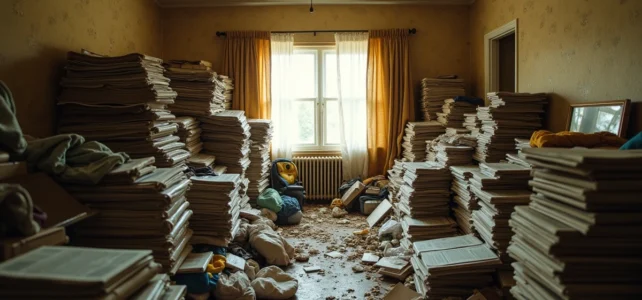
A room where you can no longer set foot, piles of newspapers blocking access to the kitchen, a hallway reduced to a path between boxes. Syllogomania, or compulsive hoarding disorder, is not just about a lack of organization. It is a psychiatric disorder recognized by the DSM-5, distinct from mere clutter, affecting an estimated 1.5 to 6% of the general population.
Compulsive hoarding and online shopping: a combination that worsens the disorder
Have you ever noticed how easy it is to order an item with just three clicks, without even leaving your couch? For someone predisposed to syllogomania, this ease of access turns an already problematic behavior into a difficult-to-stop spiral.
E-commerce and peer-to-peer resale platforms multiply opportunities to acquire items at low prices. Flash sales, personalized suggestions, next-day delivery: each commercial mechanism shortens the time between desire and possession. The item arrives before the person has had a chance to question their purchase.
A report from the WHO published in June 2024 on anxiety disorders documented a notable increase in diagnoses of syllogomania among young adults after the pandemic, directly linked to the rise in compulsive online shopping. The lockdown acted as an accelerator: social isolation, increased anxiety, and constant access to digital shops.

Among seniors, this phenomenon takes on a particular form. Many of them, unfamiliar with digital technology a few years ago, adopted online ordering during health restrictions. For those who already had tendencies toward accumulation, the dematerialization of the act of purchasing removed a physical barrier.
There is no longer a need to go out or carry items. As detailed in an article on Passez l’info, this pathology remains too little known to the general public, delaying intervention.
Syllogomania in seniors: why the disorder worsens with age
Compulsive hoarding disorder often begins in adolescence. The first symptoms go unnoticed: keeping all school notebooks, never throwing away a worn garment. By the thirties, living spaces start to shrink. But it is after 60 that the situation often becomes critical.
Several factors explain this worsening:
- The loss of a spouse or loved one creates a stronger attachment to objects, perceived as extensions of emotional memory. Throwing away a deceased person’s sweater feels, to the individual, like erasing a part of their history.
- The decline in physical abilities hinders sorting and disposal. Even when the person becomes aware of the clutter, they can no longer move the items accumulated over the years on their own.
- Social isolation reduces external interventions. Without regular visits, no one measures the extent of the problem. The home transforms into a storage space without witnesses.
The Diogenes syndrome, sometimes confused with syllogomania, is distinguished by a general disinterest in hygiene and the environment. A person with syllogomania can maintain proper personal hygiene while living in a home saturated with objects. The two disorders sometimes coexist, but their mechanisms differ.
European Directive 2025 and mandatory psychiatric evaluation
Since February 2025, the EU Directive 2025/112 on community mental health mandates the inclusion of syllogomania in psychiatric evaluations conducted by European social services. The goal is to identify health risk situations earlier.
In practice, when a social worker intervenes at the home of a reported individual, they must now assess the presence of pathological hoarding behaviors using a standardized checklist. Before this directive, sillogomania was not systematically sought during home visits, leaving many cases without follow-up.
This regulatory change alters the situation for relatives. A son or daughter who alerts social services about an elderly parent’s situation can now rely on a legal framework. The report is no longer treated as a mere hygiene issue, but as a significant mental health concern.
Limitations of this institutional approach
Screening is worthless without appropriate care. Detection creates an expectation among families, but places in specialized therapy remain limited in most EU countries. There is a risk of multiplying diagnoses without being able to offer concrete support afterward.

Digital therapies for syllogomania: initial results in France
Cognitive-behavioral therapy (CBT) remains the reference treatment for compulsive hoarding disorder. It helps the patient identify the thoughts that make separating from an object unbearable, and then gradually challenges them.
A pilot study conducted by the ANSM, published in January 2026, evaluated the effectiveness of virtual cognitive-behavioral therapies using virtual reality. The principle: expose the patient, in a simulated environment, to sorting and decluttering scenarios. The person practices letting go of a virtual object before doing so in reality.
Patients who participated in these trials reported a notable reduction in relapses compared to those followed in traditional CBT alone. The simulation allows for repeating the exercise as many times as necessary, without the immediate emotional burden of the real home.
For isolated or mobility-reduced seniors, these digital tools offer a logistical advantage. The session takes place remotely, without travel, which removes one of the major barriers to accessing care in this population.
Syllogomania remains a disorder where shame and denial significantly delay the request for help. Whether it concerns an elderly relative whose home is gradually filling up or a young adult whose online orders are piling up, the first step is to name the problem for what it is: a mental health disorder, not a character flaw.