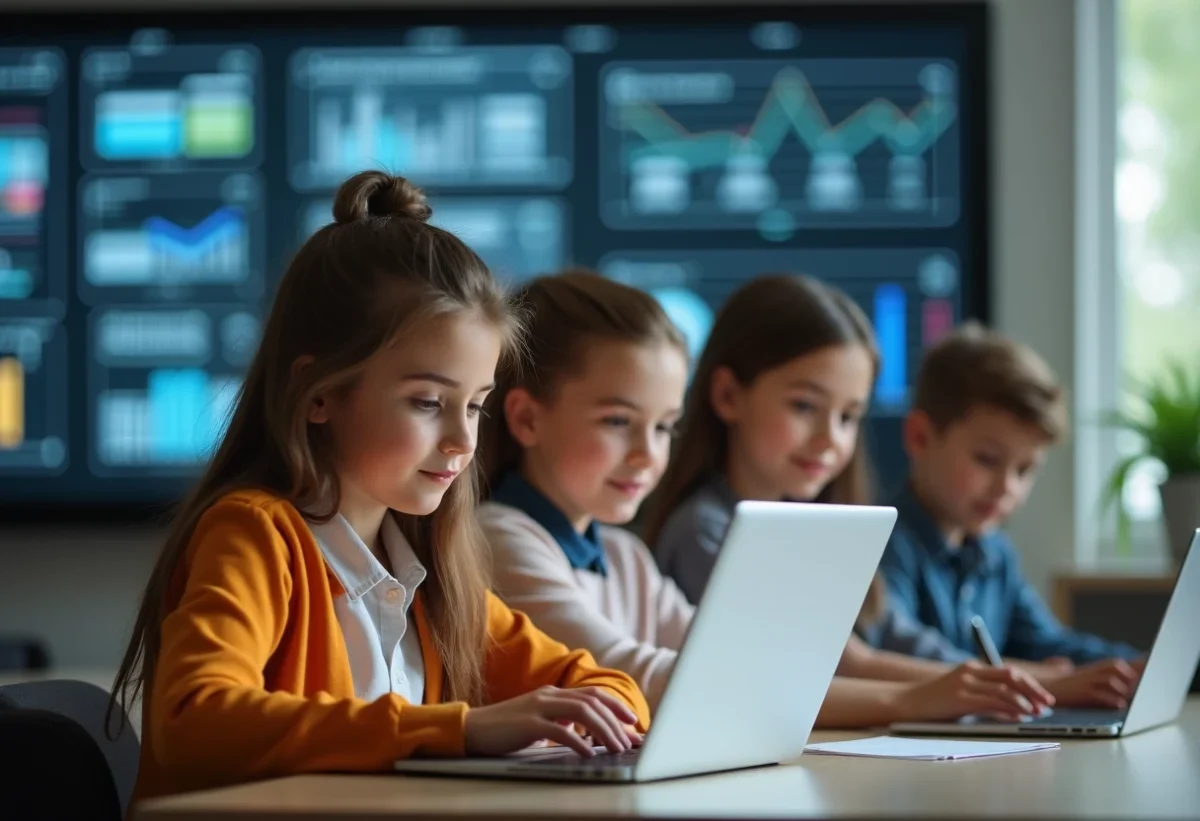
Classrooms have taken an unexpected turn with the arrival of digital portals, radically transforming the educational experience. These interactive platforms provide students with personalized and dynamic resources, thereby facilitating a more engaging and tailored approach for each individual.
Teachers benefit from sophisticated analytical tools to track progress and adapt their methods in real time. This technological revolution paves the way for a more inclusive and flexible education, where learning is no longer limited by the physical walls of the school.
Digital Portals: A Revolution in Learning
The digital revolution, driven by EdTech, is profoundly transforming education. This sector attracts colossal investments from giants like Google, Microsoft, Amazon, and Apple. Their solutions, such as Google Workspace for Education and Microsoft Teams for Education, are redefining teaching and learning methods.
MOOCs (Massive Open Online Courses) are a cornerstone of this transformation. Platforms like Coursera and edX offer global access to quality courses, while initiatives like Khan Academy and Quizlet provide interactive educational resources. Duolingo stands out in the field of language learning, making this skill accessible to everyone.
The integration of immersive technologies, such as virtual reality and augmented reality, enriches educational experiences. These tools allow for the creation of more engaging and interactive learning environments, making abstract concepts more tangible for students.
Consider the portal moncollege-Valdoise which illustrates this digital innovation. It offers an intuitive interface and personalized resources, facilitating learning and collaboration between students and teachers. This model could well become the norm in the near future, redefining the contours of traditional education.

The Impacts of New Digital Tools on Education
The integration of AI in education is at the heart of current debates. In developed countries, this technology is revolutionizing teaching and learning methods. Strong technological infrastructures enable rapid and effective adoption of digital tools.
Developing countries, on the other hand, face major challenges. Limited access to quality technological infrastructure hinders the integration of AI and other digital tools. UNESCO, through its initiatives, seeks to promote technological inclusion in these regions. André Tricot, an education expert, emphasizes that these disparities must be bridged to ensure equitable education on a global scale.
Initiatives led by Gérard Giraudon, affiliated with Inria, and Margarida Romero, director of the Laboratory of Innovation and Digital for Education at Université Côte d’Azur, show the way. They highlight the potential of digital technologies to transform education. These experts agree on the necessity of developing digital skills among both teachers and students.
| Actor | Role |
|---|---|
| André Tricot | Education Expert |
| Gérard Giraudon | Affiliated with Inria |
| Margarida Romero | Director of the Laboratory of Innovation and Digital for Education |
The impacts of new digital tools are manifold. They allow for personalized learning, greater accessibility to educational resources, and an improvement in digital skills. These technological advancements are crucial to addressing the educational challenges of the 21st century and preparing young generations for a digital future.