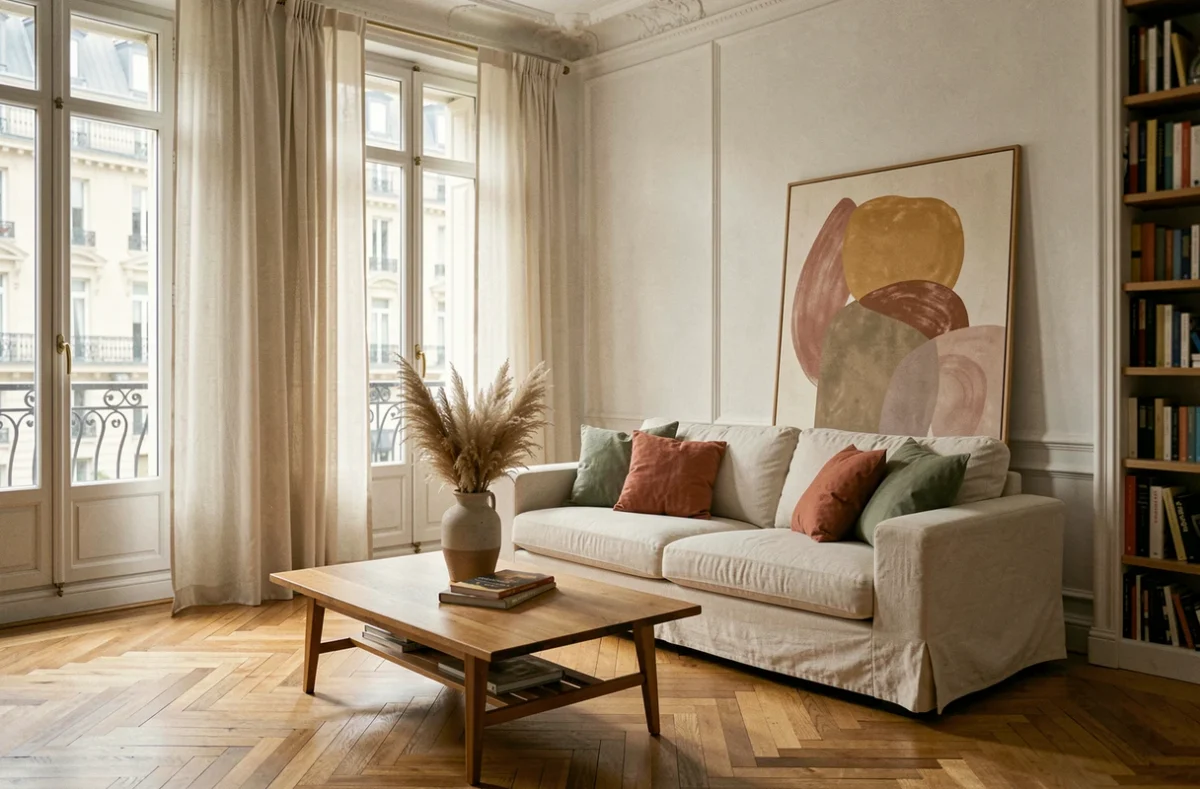
The decorative positioning known as “French touch” relies on choices of materials, finishes, and lines that reflect a precise manufacturing know-how. Maisonea and The Art Avenue embody two complementary facets of this approach: one structures the space with furniture, while the other dresses it with wall art. Understanding how these two registers interact allows for the composition of a coherent interior, far from decorative accumulation.
Regulatory constraints redefining French touch furniture
Environmental labeling applied to furniture is entering a concrete phase. The Ministry of Ecological Transition conducted experiments on a labeling method in spring 2026, with a proposed method expected in the second half of 2026. For brands that claim a French grounding and noble materials, this evolution requires documenting each stage of production.
The upcoming ban on PFAS in upholstery textiles also changes the game. Stain-resistant and water-repellent treatments applied to sofas, cushions, and curtains will need to be reformulated. We recommend checking now if the fabrics offered by a manufacturer use PFAS-based finishes, as these products will gradually be removed from the market.
The European directive 2024/825, applicable since September 27, 2026, regulates generic environmental claims. A piece of furniture presented as “eco-responsible” or “sustainable” without verifiable justification exposes the brand to sanctions. When browsing the French touch according to Maisonea, one realizes the importance of this transparency in the choice of proposed collections.
Materials and finishes: what distinguishes a French design piece
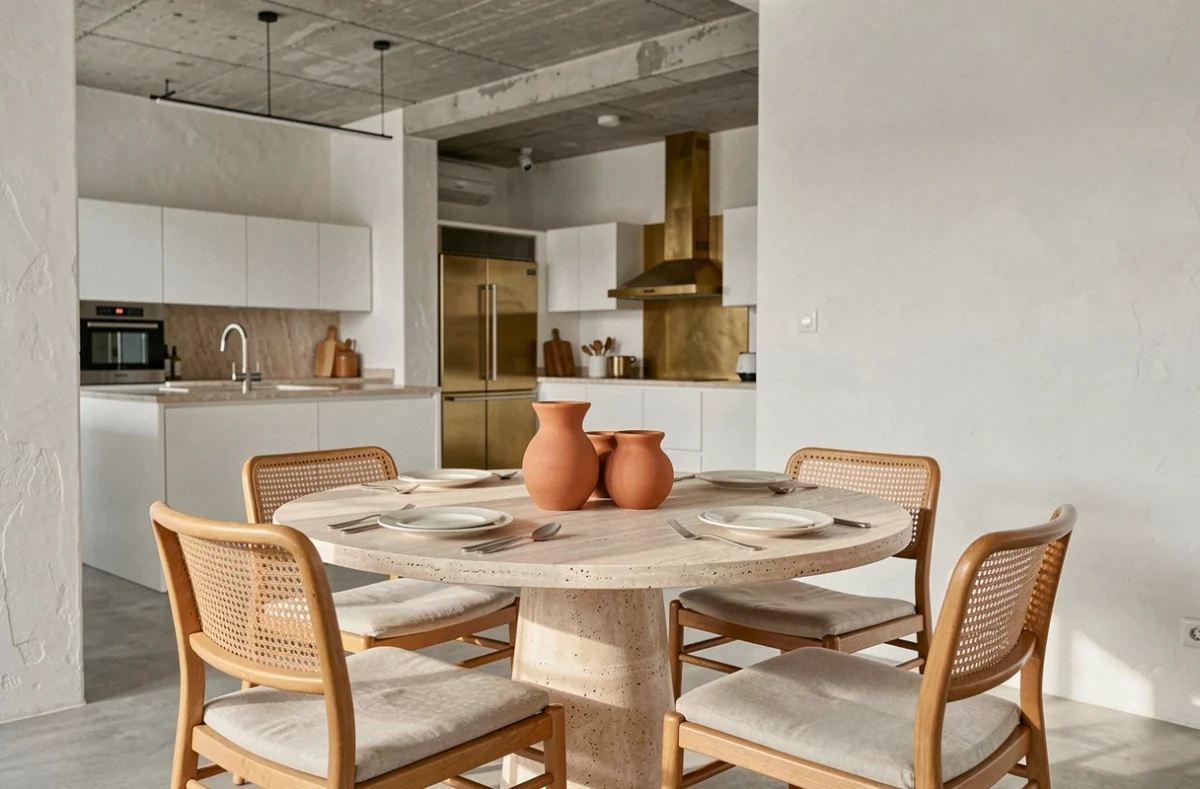
A sofa or table stamped with French touch is not just about a clean line. The choice of materials determines durability and the final appearance. Walnut, solid oak, and washed linen dominate the current collections of French workshops, in contrast to melamine particle boards that saturate the entry-level market.
The trend of soft curves, inherited from the 1970s but reworked with contemporary proportions, structures modern furniture. Rounded seats, curved legs, and tabletops with softened corners create a recognizable formal vocabulary.
Technical criteria to examine before purchase
- The density of the seat foam on a sofa: below a certain threshold, comfort degrades within months. Prefer high-resilience foam over standard polyether foam
- The type of wood finish: a natural oil ages and renews, whereas a polyurethane varnish freezes the appearance but resists stains better
- The assembly: mortise and tenon joints and dowels indicate workshop craftsmanship, while staples and hot melt adhesives betray quick industrial production
- The detailed textile composition, made mandatory by French regulations, which must mention the fabric’s place of manufacture
These technical points distinguish furniture designed to last from a decorative product with rapid obsolescence. A French workshop mastering its production chain can justify each component, which meets the requirements of the anti-greenwashing directive.
Paintings and wall art: the contribution of The Art Avenue in a structured interior
The Art Avenue offers pop art paintings and design reproductions that function as accent pieces. In a space furnished with sobriety, a large canvas creates a focal point that directs the gaze and hierarchizes the room.
Wall art replaces the overload of small decorative objects. A single well-sized painting on a main wall has more impact than an accumulation of mismatched frames. This approach aligns with the principle of contemporary French decoration: few elements, but each chosen with intention.
Integrating a painting into a French touch furnished space
The scale relationship between the painting and the adjacent furniture determines the visual balance. Above a sofa, the width of the painting should represent about two-thirds of the width of the seat. Too small, it floats. Too wide, it overwhelms.
The color palettes of the pop art collections (vivid flat colors, strong contrasts) particularly match with furniture in neutral tones. A linen sofa in ecru or a table in natural walnut absorbs the visual energy of the painting without competing with it.
Indoor air quality and decorative choices
Volatile organic compounds emitted by new furniture, paints, and certain textiles directly affect the air quality of a home. Furniture made in France with low VOC finishes reduces this exposure, especially in poorly ventilated rooms.
Canvas prints use inks whose composition varies significantly from one manufacturer to another. Water-based inks, solvent-free, limit emissions once the painting is hung. This criterion, rarely mentioned in product sheets, deserves to be verified with the seller.
The combination of healthy furniture and low-impact decorative elements creates an interior that respects both aesthetics and breathing comfort. We observe that brands positioned in the French touch are beginning to integrate this data into their communication, driven by the strengthened regulatory framework.
Composing a coherent French touch interior with Maisonea and The Art Avenue
A common mistake is to treat furniture and wall decoration as two independent purchases. A successful interior articulates the volumes of the furniture with the wall surfaces. The sofa interacts with the painting above it, the coffee table responds to the lines of the frame.
Maisonea structures this approach by offering collections of design furniture tailored for French interiors, with dimensions suited to the average surfaces of hexagonal homes. The Art Avenue complements this work with wall pieces that bring personality without sacrificing the readability of the space.
The result relies less on a high budget than on a coherence of choices: authentic materials, traceable manufacturing, a controlled palette, and a limited number of strong pieces that occupy the space without saturating it.