Dyeing salt-and-pepper hair does not pose the same challenge as coloring uniformly pigmented hair. The mixture of white fibers (lacking melanin) and still-colored fibers absorbs pigments unevenly, leading to visible shade discrepancies from the very first application. Comparing the types of men’s hair color available, their technical constraints, and their behavior on this particular mixture helps avoid disappointing results.
Permanent, semi-permanent, or grey blending: what each formula actually covers
The choice of dye type determines both the duration of the result, the level of coverage for white hair, and the risk of an artificial effect. Here is a comparison of the three main options for a man with salt-and-pepper hair.
| Type of coloring | White coverage | Average hold | Risk of helmet effect | Root maintenance |
|---|---|---|---|---|
| Permanent with ammonia | Total (up to 100%) | Several weeks | High if shade is too uniform | Visible regrowth within 3 weeks |
| Semi-permanent (tone on tone) | Partial to good | Several shampoos | Low | Gradual fading |
| Grey blending (progressive fade) | Partial and intentional | Variable depending on technique | Very low | Naturally blended regrowth |
Permanent coloring remains the only option capable of covering all white hair. However, it creates a sharp demarcation at the regrowth, necessitating frequent touch-ups. On a short men’s cut, this line of demarcation appears very quickly.
To delve deeper into the subject and tailor the choice to your situation, the hair tips on Kristal Beauté detail the options based on the percentage of whites and the desired result.
The trend for 2026 clearly leans towards grey blending, a technique that does not aim to eliminate grey but to blend white hair into the mass with shades close to the natural color. The result appears less worked, and the regrowth does not create a harsh visual break.
PPD and allergic risk: the parameter that most guides ignore
Permanent dyes capable of producing dark tones (chestnut, brown) rely on oxidizing dyes, primarily PPD (paraphenylenediamine) or PTD. These molecules are regulated by European cosmetic legislation, with a limit set at 2% of free PPD in the ready-to-use preparation.
This regulatory threshold does not eliminate the risk. An allergic reaction can occur even below this concentration, including in a man who has previously used the same product without issue. The European regulation also expands the list of allergens to declare, which also affects the fragrances contained in the dyes.
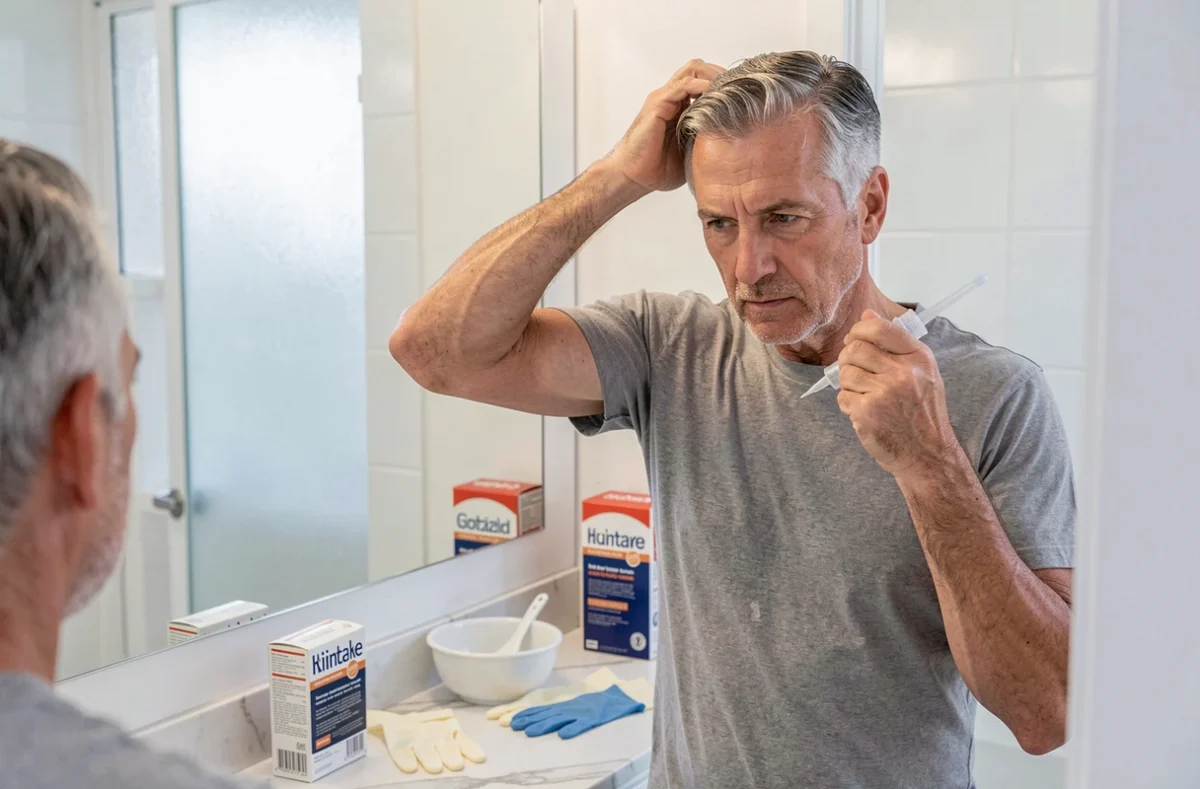
- Perform a patch test at least 48 hours before each application, even if the same product has been used repeatedly, remains the only reliable precaution against a reaction to PPD
- Ammonia-free dyes do not mean PPD-free: check the INCI list on the packaging, as PPD may be included in a so-called “gentle” formula
- Plant-based dyes (henna, indigo) avoid this specific allergic risk, but their ability to achieve uniform dark shades on a salt-and-pepper mixture requires a two-step method (base then color)
For a man dyeing his hair for the first time, this parameter weighs as heavily as the choice of shade. A contact allergy to the scalp produces itching, swelling, and sometimes prolonged eczema.
Choosing a men’s shade for salt-and-pepper hair: the discrepancies that create a misstep
The most common misstep does not come from the application technique but from the choice of a shade too far from the natural color. On salt-and-pepper hair, the reference color is neither white nor the former brown: it is the mixture perceived by the eye.
Going down more than one tone from the still-pigmented natural base creates excessive contrast with the skin of the face. This contrast is more pronounced in men because the short cut directly exposes the hair-skin junction at the temples and nape.

Chestnut, ash blonde, or natural tone: what result on the white and pigmented mixture
A white hair absorbs more pigments than a still-colored hair. Therefore, applying a medium chestnut on salt-and-pepper results in white hair appearing darker than the remaining natural hair, reversing the expected contrast. The result appears darker in the whitest areas.
To limit this discrepancy, two approaches work better than uniform coloring:
- Choose a shade half a tone lighter than the remaining natural color, so that the white hair approaches the result without exceeding it
- Opt for an ash shade (ash blonde or ash chestnut) rather than a warm shade, as golden or coppery highlights accentuate the difference in absorption between white and pigmented fibers
- Reduce the processing time by a few minutes compared to the manufacturer’s recommendation if the proportion of whites exceeds half of the hair
Maintaining a men’s dye on gray hair: frequency and suitable products
A classic shampoo opens the hair cuticles and accelerates the washing out of deposited pigments. On dyed salt-and-pepper hair, this washing out does not occur uniformly: previously white hair loses its color faster than naturally pigmented hair.
A sulfate-free shampoo slows this process. Anti-yellowing shampoos (purple pigments) serve another purpose: they neutralize the yellow tones that appear on uncolored white hair or between applications. Confusing the two functions leads to using an anti-yellowing product on still-fresh coloring, which alters the chosen shade.
The frequency of touch-ups directly depends on the initial technique. A permanent chestnut color on salt-and-pepper requires root touch-ups every three to four weeks. A grey blending, because it plays on a fade, remains consistent for much longer without intervention.
The most reliable parameter for deciding between total coverage and progressive blending remains the speed of regrowth. A man with fast-growing hair will have a better effort-result ratio with grey blending than with a full permanent that requires intensive maintenance.