
The humanist wedding has no legal value in France. This reality, often overlooked by guides to secular ceremonies, conditions the entire organization of a couple wishing for a union that is both personalized and recognized by the State. The question then arises in practical terms: how to articulate the mandatory visit to the town hall with a humanist ceremony, and what legal constraints frame this combination?
Civil marriage, humanist ceremony, and religious ceremony: what French law says
| Type of ceremony | Legal value | Possible personalization | Location | Officiant |
|---|---|---|---|---|
| Civil marriage (town hall) | Only recognized by the State | Very limited | Town hall or authorized annex | Civil status officer |
| Humanist ceremony | None | Total | Free (subject to authorization) | Celebrant chosen by the couple |
| Religious ceremony | None | Framed by the rite | Place of worship | Minister of religion |
The table highlights a point that many future spouses discover late: only civil marriage produces legal effects. The practical sheets from service-public.fr and the Ministry of Justice remind us that no religious or secular ceremony, including humanist ones, can replace the act drawn up by a civil status officer.
You may also like : How to Enjoy a Discounted Basic Fit Subscription: Tips and Practical Advice
Talking about “legal humanist marriage” is therefore a misleading shortcut. What is legal is the civil marriage. What is humanist is the symbolic ceremony that accompanies it. To delve deeper into this framework, humanist marriage according to Espace Mariage details the steps to follow to combine the two.
You may also like : How to Organize Unforgettable Outings in the City of Popes?
Mandatory civil formalities before any humanist ceremony in France
The humanist ceremony can only take place after the civil marriage. The civil code imposes a strict order, and circumventing it exposes one to real administrative complications.
Marriage file and publication of banns
The couple must prepare a file at the town hall of the residence of one of the future spouses. This file includes identity documents, birth certificates less than three months old, proof of residence, and a list of witnesses.
- The publication of banns is displayed for a minimum of ten days at the town hall, a legal condition prior to the celebration
- A prior hearing of the future spouses may be requested by the civil status officer to verify free consent
- The civil marriage must be celebrated in the municipality of residence of one of the spouses (or one of the parents, under certain conditions)
- No minimum delay is imposed between the civil marriage and the humanist ceremony, but the civil must always precede the symbolic
This sequence is not just a recommendation. Article 433-21 of the penal code provides for penalties in the event of a ceremony of a matrimonial nature being celebrated before the civil marriage, even if this provision historically targets religious ceremonies.
Why the civil then humanist order is non-negotiable
Case law remains rare on secular ceremonies, but recent doctrinal comments (AJ family and Family Law reviews, updated in 2024-2025) remind us that the simulation of marriage and the usurpation of signs reserved for public authority can theoretically be criminally qualified. The risk is low in practice for a humanist ceremony clearly identified as symbolic, but it exists.
Not presenting the humanist ceremony as a “marriage” in communications (invitations, couple’s website) is a sensible precaution. Using the terms “commitment ceremony” or “humanist celebration” removes any ambiguity.
Humanist ceremony: what distinguishes it from a classic secular ceremony
The terms “secular” and “humanist” are often used as synonyms. However, they cover slightly different approaches in the philosophy that underlies them.
A secular ceremony is defined by what it is not: neither religious nor civil. It is a space of total freedom without a particular ideological framework. The humanist ceremony, on the other hand, is rooted in a philosophical vision centered on the values of autonomy, empathy, and rationality. The humanist celebrant structures the ceremony around these principles, whereas a secular officiant may adapt to any wish of the couple.
In practice, this distinction is reflected in the choice of celebrant. Several international networks train humanist celebrants according to precise ethical charters. In France, no diploma or official accreditation is required to officiate a symbolic ceremony. The couple freely chooses a friend, a professional, or a trained celebrant.
Criteria for choosing a humanist celebrant
- His ability to conduct a thorough interview with the couple to understand their story and values, not just their aesthetic tastes
- His experience in writing personalized texts and managing the emotional rhythm of a ceremony
- His neutrality regarding any religious or political affiliation, in accordance with humanist principles
A celebrant who merely reads a generic script misses the fundamental objective of the humanist ceremony. Personalization relies on several weeks of preparation between the celebrant and the couple, including at least two to three meetings.
Planning the big day: articulating town hall and humanist ceremony
The main logistical constraint lies in the sequence of the two events. Several configurations exist, each with its practical implications.
Celebrating the civil marriage in the morning and the humanist ceremony in the afternoon, on the same day, remains the most common formula. It allows for the concentration of guests’ movements and a seamless transition to the cocktail. However, it imposes a tight schedule, especially if the town hall and the ceremony venue are far apart.
Dissociating the two over two different days offers more flexibility. The visit to the town hall can be done with a small group a few days prior, freeing up the main day for the humanist ceremony and reception. This option alleviates the administrative aspect and refocuses the emotion on the symbolic moment.

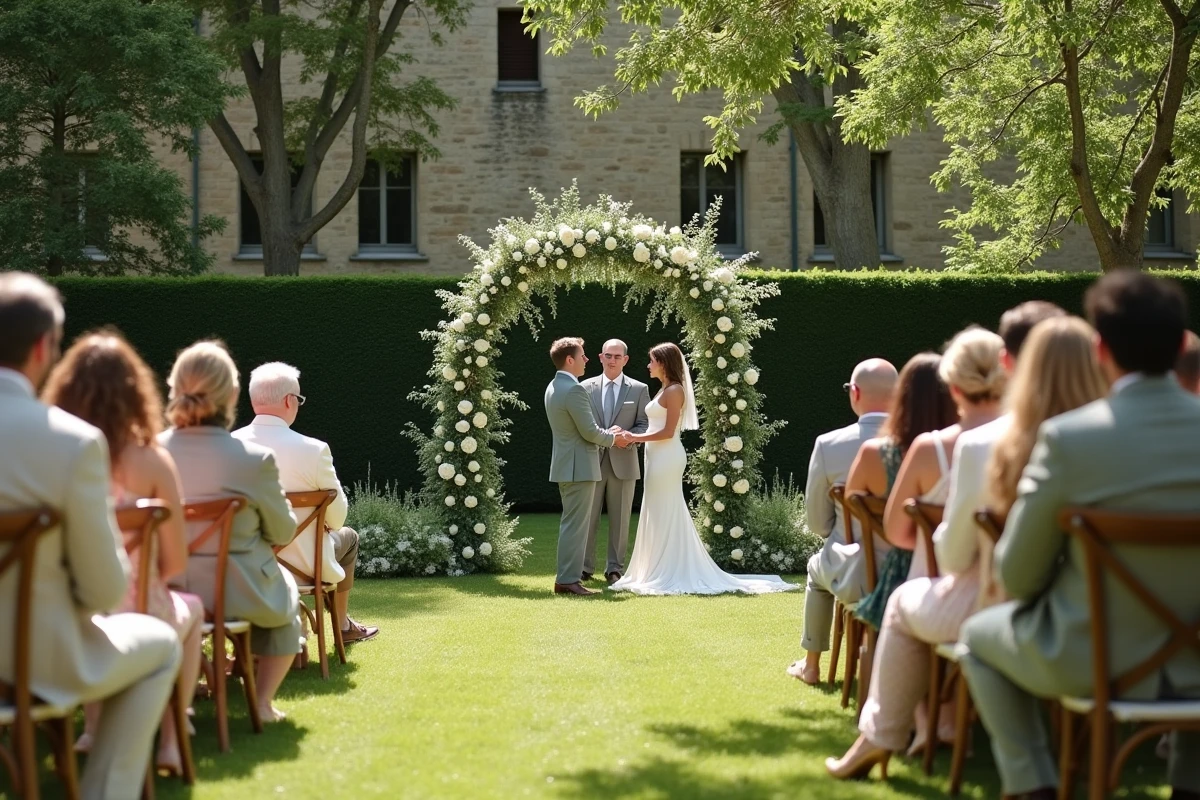
The location of the humanist ceremony is not subject to any specific marriage regulations. It is subject to the usual rules of renting or occupying a space (municipal authorization for a public place, rental contract for a private domain). A garden, a forest, a beach, a vineyard: the only limit is the owner’s agreement and the capacity to host.
The combination of a civil marriage at the town hall and a humanist ceremony at a location chosen by the couple remains the only formula that guarantees both the legal recognition of the union and total freedom of celebration. No legislative reform is announced to change this framework. Couples wishing for a humanist marriage in France must integrate this duality from the beginning of their planning, not as a constraint, but as the very structure of their project.