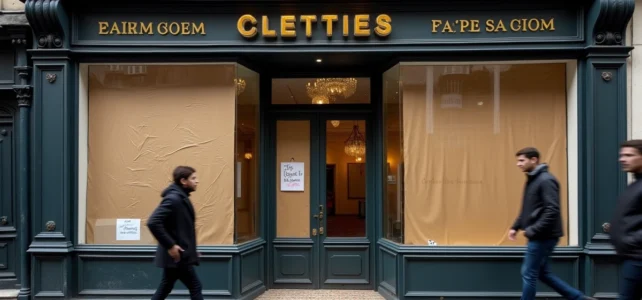
The Bouchara store on Boulevard Haussmann, in the 9th arrondissement of Paris, did not wait for the wave of closures in 2026 to disappear. Its closure, which occurred well before the group’s judicial recovery, marked a discreet yet structural turning point for the home decor and linen offer on the grand boulevards of Paris.
Replacement by fast fashion on Boulevard Haussmann: what the takeover of the Bouchara site in Paris 9 reveals
The space vacated by Bouchara on Boulevard Haussmann was taken over by H&M as early as 2010. This shift is not trivial: it reflects a lasting reorientation of the neighborhood towards mass-market clothing, to the detriment of stores specializing in home goods.
We observe that accessible decor has lost its foothold in high pedestrian traffic arteries. The economic model of a multi-story home linen store, with high maintenance, energy, and personnel costs, can no longer withstand the rents charged in this sector. Fast fashion players, with a lower average basket but a much higher stock turnover, easily absorb these locations.
Since the closure of the Bouchara store in Paris 9, no specialized home textile brand has reestablished itself on this stretch of Boulevard Haussmann. The decor segment has been replaced by fashion, cosmetics, or fast food.
Judicial recovery of Bouchara 2026: why Paris was not saved
The judicial recovery of the group at the beginning of 2026 led to the closure of more than half of Bouchara’s stores in France. Some cities received a reprieve: in Dijon, for example, the store was maintained with a reduced team. Paris did not benefit from this type of rescue.
The explanation lies in the cost structure. The large Bouchara stores, often located in city centers over several floors, bear costs that are incompatible with the margins in the home textile sector. In provincial areas, a landlord can renegotiate a lease or accept a rent reduction to keep a long-standing tenant. On Boulevard Haussmann, the land pressure leaves no room for maneuver.
An untenable fixed cost model
Heating, maintenance of the floors, specialized sales personnel: these expenses weigh heavily when revenue per square meter stagnates. Accessible decor brands operate on modest margins, and the online channel captures an increasing share of the customer base. In this context, a physical store is only justified if it generates sufficient volume to cover its fixed costs.
In Metz, where Bouchara had been present for over 70 years, the closure was experienced as the disappearance of an institution. In Paris, the departure had already been digested long ago, illustrating a temporal gap between the capital and the rest of the territory.
Accessible decor offer in Paris: the void left by Bouchara on the grand boulevards
The disappearance of Bouchara in the 9th arrondissement has not been compensated by an equivalent offer. The Haussmann neighborhood now concentrates brands positioned at two extremes:
- Premium or design brands (furniture, lighting) with high unit prices and a reduced sales area
- Fast fashion chains that occupy the large spaces once dedicated to home goods
- Pop-up stores and ephemeral concepts that do not offer a sustainable home textile range
The intermediate segment, that of home linen and mid-priced decor, has simply disappeared from the high-traffic shopping streets of Paris. This segment survives on the outskirts (commercial zones, retail parks) or online, but no longer in the historic streets of Parisian commerce.

Bouchara closures in the provinces: a social impact that Paris did not experience
The wave of closures in 2026 affected cities where Bouchara sometimes represented the last destination store in the city center. In Blois, the closure on Rue Denis-Papin caused a strong emotional reaction. In Albi, Castres, and Portet-sur-Garonne, all three stores closed simultaneously.
In these cities, the issue goes beyond just the brand. The closure of a Bouchara in the city center raises a problem of commercial vacancy. The vacated spaces, often large and multi-level, are difficult to re-rent. They require costly renovation work to accommodate a new concept.
Employment and retraining of employees
The employees affected by these closures face a tight job market in specialized retail. As highlighted by a testimony collected by France Bleu, finding an equivalent position in the city center is a challenge when local commercial offerings are contracting. In Paris, the problem does not arise in the same terms: the density of brands allows for quicker retraining, and the departure of Bouchara dates back to an earlier period.
We observe that the fate of Bouchara illustrates two distinct realities depending on the size of the city. In metropolitan areas, the brand has been seamlessly replaced by other players. In medium-sized cities, its disappearance leaves a gap in the commercial fabric that nothing fills in the short term.
The case of Bouchara Paris 9 remains a useful marker for understanding how the grand boulevards are reconfiguring. The brand did not disappear because the demand for home linen has faded, but because the large store format in the city center no longer corresponds to the economic balances of the sector. Customers still buy sheets and curtains, but they do so online or on the outskirts, where the cost per square meter is lower.