
A check is sent for cashing, a statement request, or a complaint letter to one’s financial center. The envelope is ready, the address copied down, and the question arises when passing by the mailbox: should a stamp be affixed or not? La Banque Postale is part of the La Poste group, which maintains a persistent confusion about any potential free sending.
La Banque Postale’s T Envelope: Why It No Longer Exists
For years, La Banque Postale provided its customers with T envelopes, pre-stamped by the institution. One would slip their check or form inside, drop it all in a mailbox, and the postage was covered by the bank. This system ended in 2017.
Since that date, La Banque Postale no longer distributes pre-stamped envelopes. Customers sending mail to their financial center must purchase a stamp and affix it themselves to the envelope. The historical link between La Poste and La Banque Postale does not change this rule.
If one wonders concretely whether a letter needs to be stamped for La Banque Postale, the answer is yes in the vast majority of cases. The standard envelope, whether it contains a check, a bank account details, or a cancellation letter, requires a stamp at the current rate.
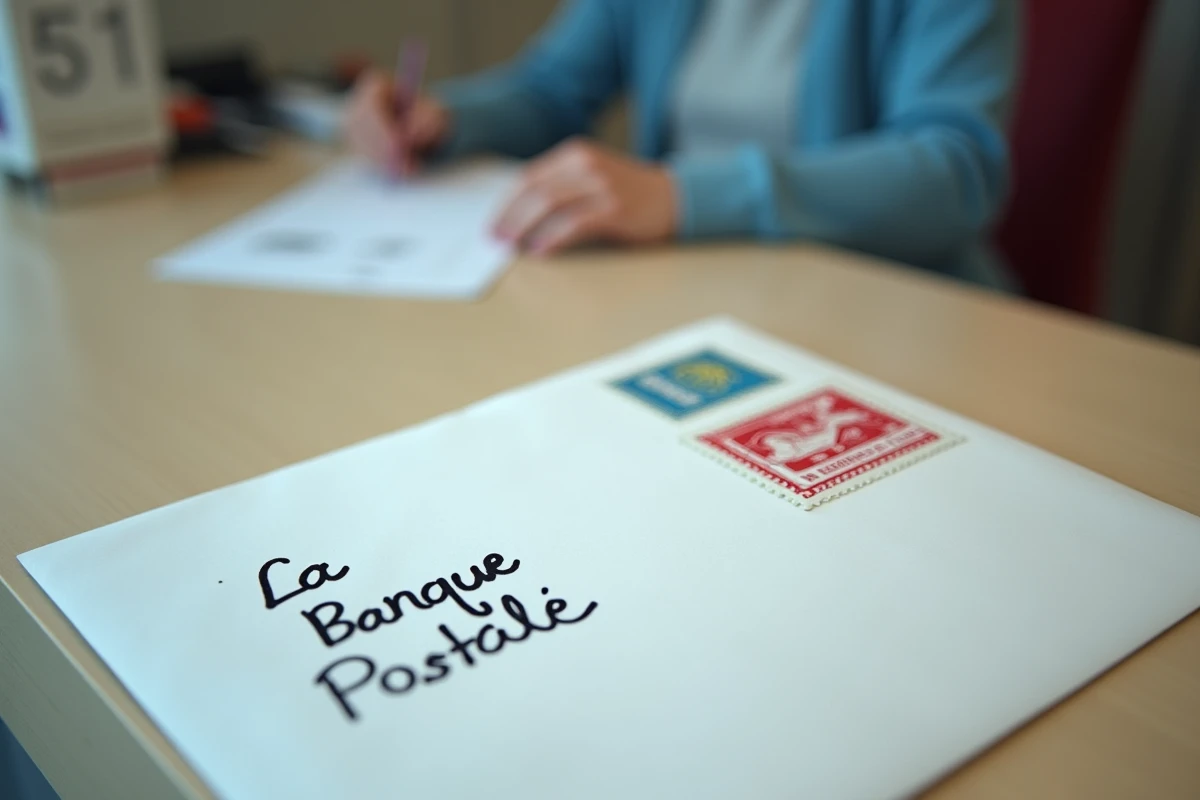
Postal Exemption and Banking Mail: What Really Applies
Postal exemption still exists in France for certain recipients. One can write to the President of the Republic without postage, and letters addressed to Santa Claus also benefit from this exemption. These cases are governed by specific regulatory texts.
La Banque Postale does not benefit from any postal exemption. Despite being part of the La Poste group, it operates as a distinct banking institution. The mail addressed to it follows the standard postal rules, just like mail sent to any other bank.
The confusion arises from the fact that post offices host both postal services and banking services. One drops off a package at the same counter where they check their account. This physical proximity does not create any special rights regarding postage.
Particular Cases to Know
- A registered letter addressed to La Banque Postale follows the usual rates for registered mail, with acknowledgment of receipt if desired. Postage is paid and higher than for a simple letter.
- Mail sent from abroad to a financial center in France must comply with the international rates of the country of dispatch. No exemption applies.
- Envelopes provided by other organizations (insurance companies, mutuals) that bear the mention “T” remain valid for those organizations, but they do not concern La Banque Postale.
Depositing a Check Without a Stamp: Alternatives to Postal Mail
Postal mail is no longer the only channel for transmitting documents to La Banque Postale. Returns vary on the availability of each option depending on the offices, but several alternatives avoid the question of postage.
Depositing a check at a post office remains the most direct method. One fills out a slip on-site, slips the check into the dedicated box, or hands it to an advisor. No stamp, no postal delay.
Deposit machines, available in some post offices, accept checks and cash deposits. One inserts the check along with its slip into the machine, which issues a receipt. The processing is often faster than sending by mail.
Online Services and Mobile App
La Banque Postale offers dematerialized services for some routine operations. From the online customer area or the mobile app, one can make transfers, check their statements, file a complaint, or update their contact details without sending any letters.
For operations that still require a physical document (check, signed form), visiting the office remains the solution without postage costs. This way, one avoids the cost of a stamp and the risk of losing mail in transit.

Stamp Rate and Envelope Weight: What Determines the Sending Cost
When postal mail remains the only option (geographical distance, time constraint), the postage rate depends on the weight of the envelope and the chosen format. A standard letter containing a check and a slip rarely weighs more than a few grams, placing it in the lowest weight category.
- The “green letter” format is suitable for a standard non-urgent sending. The delivery time is a few working days.
- The “priority letter” format (ecopli has been removed) reduces the delivery time but costs more.
- Registered mail with acknowledgment of receipt is required for letters with legal value: cancellation, contestation of transaction, formal notice.
A check sent by simple mail has no evidential value in case of dispute. If the amount exceeds a few dozen euros, registered mail offers traceability that protects the sender.
Before slipping the envelope into the box, one should check that the format (length, width, thickness) remains within the limits of the standard format. An envelope that is too rigid or too thick may incur a surcharge upon delivery.
The elimination of T envelopes has simplified matters: all mail addressed to La Banque Postale now follows the same rules as any postal sending in France. A stamp is mandatory, the rate depends on the format and weight, and digital or in-office alternatives often allow one to completely avoid it.