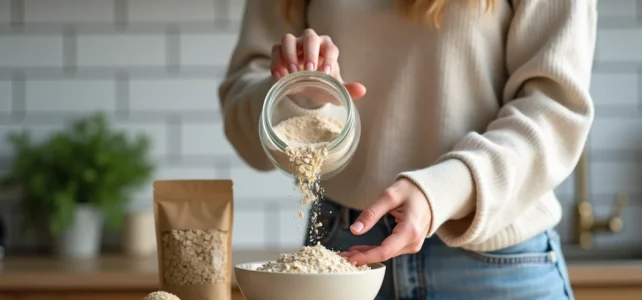
At first glance, there is really nothing separating oat flour from rolled oats. However, behind a common origin, these two forms reveal distinct profiles that weigh in both the plate and the metabolism.
Oat Flour and Rolled Oats: Where Do They Come From and How Are They Made?
Oats are a solid ally among cereals. Grown for their nutritional benefits and low environmental impact, they transform in our kitchens in various forms: from classic flakes to flour, as well as bran or gruel.
You may also like : Everything You Need to Know About Standard Poster Sizes in cm and Their Uses
Rolled oats come from the whole grain. After careful cleaning, they are steamed and then flattened: the result is these little flakes, varying in thickness, that retain the natural richness of oats, including fibers, proteins, vitamins, and minerals. Depending on their size, they adapt to all uses, from generous muesli to creamy porridge.
Oat flour, on the other hand, appears as a fine powder. It comes from grinding the flakes or directly from the grains. This transformation does not remove the nutrients, but the texture changes everything: the flour slips into recipes for breads, cakes, pancakes, or sauces, modulating consistency and digestibility.
Read also : Everything You Need to Know About Essential Property Diagnostics Before Selling in Rennes
In terms of cultivation, oats check the boxes for sustainable agriculture: low in fertilizer or treatments, they fit into organic rotations and contribute to soil health. This ecological dimension fully aligns with current concerns about the difference between oat flour and rolled oats and influences the choices of many consumers.
What Really Distinguishes Oat Flour from Rolled Oats in Daily Life?
It’s not just a matter of texture: the distinction between rolled oats and oat flour influences cooking methods, eating habits, and even the impact on the body. The flakes, made from the flattened whole grain, remain rich in fibers, dense, and filling. Their low glycemic index slows sugar absorption and prolongs satiety. With nearly 10 g of fiber per 100 g, they stand out for their beta-glucan content, known for moderating LDL cholesterol. In terms of recipes, they find their way into porridges, mueslis, pancakes, granolas, or smoothies, offering a different chew each time.
Oat flour, reduced to powder, shares a low glycemic index (generally between 25 and 40 depending on the brands) and a high fiber content, around 7 to 10 g per 100 g. It mixes easily into bread doughs, pastries, pancakes, or to thicken a sauce. Its nutritional contribution remains stable: complex carbohydrates, proteins, vitamins, and minerals. It appeals to those looking for an alternative to wheat flour, especially in gluten-free diets (provided a guaranteed trace-free version is chosen).
To clarify, here are the main comparison points:
| Rolled Oats | Oat Flour | |
|---|---|---|
| Texture | Fibrous, crunchy or melting | Powdery, homogeneous |
| Glycemic Index | Low | Low (25-40) |
| Fiber | 10 g/100 g | 7-10 g/100 g |
| Uses | Porridge, muesli, cakes | Breads, pancakes, sauces |
The difference between rolled oats and oat flour is thus expressed in texture, digestion speed, and the diversity of culinary uses. But in both cases, we find the proteins, vitamins, and minerals that give oats their reputation among healthy eating enthusiasts.
Choosing Wisely According to Your Needs: Uses, Nutritional Benefits, and Practical Tips
Why choose one over the other? It all depends on the desired effect, the recipe, the preparation method, or any dietary constraints. Rolled oats, whether rustic or melting, naturally fit into breakfast, in porridges, mueslis, or granolas. Their structure preserves the fibers and beta-glucans, which are beneficial for satiety, blood sugar stability, and reducing LDL cholesterol. This fiber richness also supports transit and gut flora, an asset for anyone aiming for steady energy or following a lighter diet.
Oat flour, discreet yet valuable nutritionally, slips into all sorts of preparations: breads, cakes, pancakes, cookies. Its fine texture allows it to replace all or part of conventional flours, practical for those monitoring their gluten intake (provided it has the appropriate label). It provides complex carbohydrates, plant proteins, as well as a range of vitamins (B1, B3, B6, E) and minerals like iron, magnesium, zinc, or phosphorus.
According to your needs, here are some useful guidelines to guide your choice:
- For a hearty breakfast or a fiber-rich snack, rolled oats are to be preferred, whether plain or in porridge.
- To lighten a sweet or savory recipe, or to thicken a sauce, oat flour does the job perfectly.
In any case, both products share validated health benefits: cholesterol reduction, better satiety control, prevention of cardiovascular diseases. However, digestive tolerance varies from person to person. It is always better to hydrate flakes or flour to avoid a heavy feeling, and adjust the quantity according to sensitivity, especially for children, athletes, or in the context of specific diets.
To each their oats, to each recipe its texture: between flakes and flour, the choice is never trivial. It shapes, day by day, a different way to nourish the body and savor the diversity of cereals.